WIZZ AIR: A Tale of Two Quarters — Recovery, Discipline and the Cost of Transformation | Earnings Conference Call Highlights
ANDRIEVSKII.CH | November 12, 2026
Wizz Air's second-quarter results suggest that the airline is beginning to recover from a difficult start to its financial year. Revenue increased by 20% to €2.29 billion, while passenger numbers and available seats rose by 27%. Revenue per available seat kilometre (RASK) returned to positive territory, increasing by 0.5% after an 8.1% decline in the first quarter.
Chief Executive József Váradi described the first half of FY2027 as “a tale of two quarters”. The first was dominated by geopolitical disruption, rising fuel prices and capacity adjustments. The second demonstrated stronger demand, improving bookings and greater operational stability.
Chief Financial Officer Veronika Špaňárová confirmed that EBITDA, operating profit and net profit after tax all exceeded their levels a year earlier.
Revenue Recovery and Pricing Discipline
The improvement was particularly visible in August and September, following a relatively neutral July. According to Chief Commercial Officer Ian Malin, positive booking momentum continued into October.
However, the headline RASK improvement requires qualification. Adjusted for shorter average flight distances, unit revenue declined by 2.5% year on year, reflecting the airline's ongoing network restructuring.
Management is increasingly prioritising ticket yields over passenger volumes. Váradi emphasised that maximising aircraft occupancy is not necessarily the most profitable strategy when additional passengers generate additional operating costs.
For the fourth quarter, booking visibility remains limited, with less than 20% of capacity sold. Nevertheless, RASK on existing bookings was running at a high-single-digit percentage above the comparable position last year.
Fleet Modernisation: Short-Term Costs, Long-Term Advantages
The principal challenge remains the financial cost of fleet transformation.
Wizz Air expects second-half depreciation expenses to increase by approximately €110 million year on year, while income from sale-and-leaseback transactions and compensation is projected to decline by €170 million.
Consequently, full-year nonfuel unit costs are expected to rise by a mid-single-digit percentage, although underlying operating costs should remain at least stable.
Nearly 80% of the fleet has already transitioned to newer Airbus NEO aircraft, offering approximately 20% lower fuel consumption than the previous generation.
Management expects transitional cost pressures to moderate in FY2028 and continues to target nonfuel unit costs of €0.03 by FY2030.
Liquidity, Capacity and Competitive Opportunities
Wizz Air ended the reporting period with €2.39 billion in cash and a 12-month liquidity ratio of 37.6%.
The airline expects third-quarter capacity to increase by 12% in available seat kilometres and 19% in available seats. Importantly, much of this expansion will come from aircraft returning to service following engine-related groundings rather than additional fleet purchases.
For the first half of FY2028, management anticipates capacity growth of approximately 10–15%, depending on the measurement used.
Wizz Air is also expanding selectively into markets where competitors have reduced their presence, including Moldova and Italy, while strengthening its Romanian domestic network.
Andrievskii Verdict
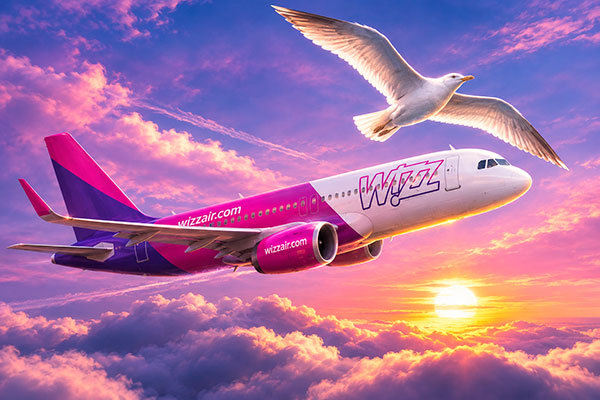
A seagull that has learned to fly above the storm does not measure its freedom by the height of the waves below.
It knows that the wind which once threatened to break its wings may one day carry it higher than it ever imagined.
The sky has not become kinder. The bird has simply learned to fly differently.
And perhaps the greatest mistake is to confuse a difficult flight with a destination that cannot be reached.
Disclaimer: This publication is provided for informational purposes only and does not constitute personalised investment advice or a recommendation to buy or sell securities. Investments in financial instruments involve risks, including the potential loss of capital.
Aleksei Andrievskii | Advisory Board Member, Bendura Bank AG | Liechtenstein