When Peace Becomes an Economic Catalyst: Vinci and Bouygues Ahead of Europe's Next Infrastructure Cycle
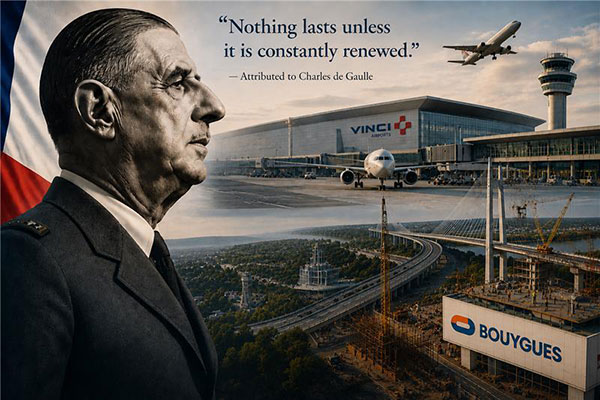
“Nothing lasts unless it is constantly renewed.”
— Attributed to Charles de Gaulle
Today, my investment attention is focused on two of France's largest infrastructure groups — Vinci and Bouygues. To me, these are not merely defensive dividend stocks, but long-term investment ideas capable of unlocking significant value during the next economic and infrastructure cycle.
About VINCI
VINCI is a global leader in concessions, energy solutions and construction. The Group employs approximately 294,000 people in more than 120 countries. It designs, finances, builds and operates transport, energy and urban infrastructure while adhering to the principles of sustainable development, responsible business conduct and long-term value creation for its clients, shareholders, employees, partners and society.
About VINCI Airports
VINCI Airports is the world's leading private airport operator, managing the development and operation of more than 70 airports across 14 countries. The company combines investment capacity, engineering expertise and operational know-how to modernise airport infrastructure and improve its efficiency. In 2016, VINCI Airports became the first airport operator to adopt an international environmental strategy, setting the objective of achieving net-zero emissions (Scope 1 and Scope 2) across its entire network by 2050. The market capitalisation of the VINCI Group is approximately €69.2 billion.
Bouygues
Bouygues is a leading French diversified group with more than 70 years of history, employing approximately 200,000 people in 80 countries. The Group holds leading positions in large-scale construction and civil engineering (Bouygues Construction, Colas, Bouygues Immobilier), telecommunications (Bouygues Telecom), media (TF1 Group), and engineering services for the energy and climate sectors (Equans). The company's market capitalisation is approximately €18.5 billion.
Despite their different business models, both companies already possess assets that are well positioned to benefit from a gradual reduction in geopolitical risk, moderating inflation and the recovery of the long-term investment cycle.
The investment thesis extends far beyond the assessment of individual political events. It is based primarily on business quality, the scale of infrastructure assets, financial resilience and the ability of Vinci and Bouygues to create value throughout the entire economic cycle. A more favourable macroeconomic environment would simply reinforce competitive advantages that already exist.
For the infrastructure sector, such a scenario follows a clear economic logic. Lower energy prices could reduce the cost of construction materials and transportation, while easing inflation would create a more favourable environment for financing large-scale infrastructure projects.
Vinci already possesses a diversified platform capable of benefiting from these developments. Passenger traffic across its airport network reached 85.1 million, while the normalisation of the global transport system could gradually improve the performance of this business. At the same time, the voluntary acquisition offer for Germany's All for One strengthens the company's position in corporate IT integration and digital infrastructure.
Another important strength is the company's disciplined capital allocation policy. Its €200 million share buyback programme, combined with a dividend yield of approximately 4.3%, provides an attractive current return.
Bouygues also continues to strengthen its competitive position. Its participation in the restructuring of SFR enhances its telecommunications business, the acquisition of U.S.-based Vannoy Construction expands its presence in the American market, and major projects, including Amazon's logistics centre near Lyon, demonstrate the company's high level of engineering expertise.
Both groups possess the experience, financial resources and international presence required to participate in the next cycle of public and private infrastructure investment. At the same time, their investment appeal is not limited to long-term expectations: they continue to pay dividends, expand their geographic footprint and invest in businesses capable of supporting earnings growth regardless of where the construction cycle stands.
Today, Vinci trades at approximately 13.7 times forward earnings, while Bouygues trades at around 16.1 times. For companies of this scale, with resilient cash flows and highly diversified operations, these valuations appear relatively undemanding.
Andrievskii Verdict
Vinci and Bouygues are not investments based on a single political event. They are investments in companies that continue to strengthen their competitive positions, expand internationally, develop digital capabilities and maintain disciplined capital allocation.
Vinci combines transport infrastructure, airports, concessions, energy and digital transformation. Bouygues brings together construction, transport infrastructure, telecommunications and international engineering projects. Both companies possess the scale, experience and financial strength required to participate in the next major cycle of infrastructure investment.
Additional appeal comes from their dividend distributions, reasonable valuations and ability to generate resilient cash flows. It is precisely this combination of business quality, financial resilience and long-term growth potential that forms the basis of my interest in both companies.
If such a scenario begins to unfold, history provides a valuable point of reference.
The experience of the Marshall Plan demonstrates that large-scale economic assistance is most effective when financial resources are closely aligned with a long-term geopolitical strategy. In today's world, this classical model is taking on new forms: for Ukraine, reconstruction may become an institutional bridge towards the European Union, supported by profound domestic reforms, while in the case of Iran, economic opening could take the form of a large-scale investment agreement built upon reciprocal security commitments. In both cases, success will ultimately depend on the ability of the international community to establish transparent governance mechanisms capable of transforming devastated or isolated regions into stable, globally integrated centres of economic development.
Aleksei Andrievskii | Advisory Board Member, Bendura Bank AG | Liechtenstein