When Fear Outweighs Fundamentals: The Irrationality of Stock Markets
ANDRIEVSKII.CH | October 8, 2026
Renowned economist Mohamed El-Erian has repeatedly observed that during periods of instability, financial markets can be driven by forces largely disconnected from corporate fundamentals. In a Bloomberg article published on February 7, 2018, he examined how sharp market fluctuations can occur even against a backdrop of improving economic conditions and corporate performance. Today, this phenomenon is once again evident across global financial markets.
On Thursday, Brent crude oil climbed above $102 per barrel following reports that the Trump administration had instructed the Pentagon to prepare options for military strikes against Iran, potentially before the November US midterm elections. These reports challenge the prevailing assumption that President Donald Trump would avoid further escalation ahead of the vote. Additional pressure on oil markets came from Tropical Storm Isaiah, which disrupted more than 510,000 barrels per day of production in the Gulf of Mexico. Meanwhile, Middle Eastern oil exports have been gradually recovering, although attacks on tankers in the Strait of Hormuz and Houthi strikes against Saudi Arabia continue to sustain regional tensions.
The Strait of Hormuz now influences far more than oil prices. Its significance extends to global investor sentiment, with potential disruptions to energy supplies affecting inflation expectations, interest rates, transportation costs and corporate profitability. Geopolitical risk has become an increasingly powerful driver of asset valuations across virtually every sector of the global economy.
“What if?” has perhaps become the defining question for investors. What if the Pentagon is preparing a large-scale military operation? What if any strike is limited? How would Iran respond? And what if, instead of another military confrontation, Washington and Tehran unexpectedly reach an agreement over Iran’s nuclear programme? The details of military planning remain undisclosed, as do the ultimate political decisions. The world stands at a crossroads between further escalation and the possibility of a relatively swift diplomatic settlement. Even a military strike would not necessarily lead to a prolonged conflict, while a diplomatic breakthrough could arrive unexpectedly.
Under such circumstances, corporate fundamentals temporarily lose much of their usual influence over share prices. Consistent earnings, positive cash flow and attractive valuation multiples offer little protection against sudden shifts in market sentiment. A single report suggesting renewed negotiations can trigger a sharp rally in airline and industrial stocks, while subsequent news of military preparations can reverse those gains almost immediately. Yet nothing material may have changed in the underlying businesses.
During periods of uncertainty, a share price does not always reflect the value of a business. Sometimes, it merely reflects the price of fear surrounding an event that has yet to occur.
Until greater clarity emerges, markets are likely to remain volatile, with sharp and occasionally contradictory price movements. Economic data and corporate earnings continue to determine long-term business value, but geopolitical expectations can dominate investment decisions over shorter horizons.
Andrievskii Verdict
During periods of geopolitical uncertainty, the central question is not so much the accuracy of forecasts as the ability of an investment portfolio to withstand different scenarios. A similar perspective is reflected in the assessments of major international financial institutions.
J.P. Morgan — Geopolitics Cannot Be Reliably Predicted. In a publication dated August 28, 2026, the bank described heightened volatility as a new reality for financial markets. Geopolitical conflicts and fluctuations in commodity prices are making market movements sharper and less predictable. At the same time, J.P. Morgan Asset Management emphasises the importance of maintaining a long-term investment horizon, diversification and avoiding panic-driven selling.
Against this backdrop, defensive sectors, including utilities and consumer staples companies such as Nestlé, take on greater significance. Broad diversification across industries, currencies and financial instruments helps reduce a portfolio’s exposure to individual geopolitical scenarios. At the same time, market volatility creates opportunities to acquire high-quality businesses whose share prices have come under pressure from geopolitical developments rather than deteriorating fundamentals.
The outcome of the confrontation involving Iran remains uncertain. However, a long-term investment strategy cannot depend on predicting Pentagon decisions or political agreements. Beyond the current instability lies the prospect of peace, economic recovery and a renewed focus on the fundamental value of businesses.
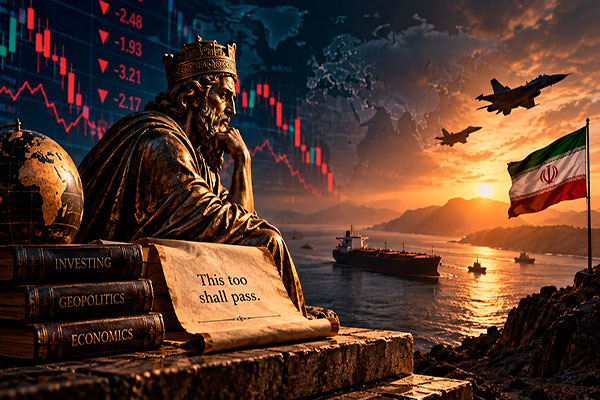
As the ancient saying traditionally attributed to King Solomon reminds us: “This too shall pass.”
Disclaimer: This publication is provided for informational purposes only and does not constitute personalised investment advice or a recommendation to buy or sell securities. Investments in financial instruments involve risks, including the potential loss of capital.
Aleksei Andrievskii | Advisory Board Member, Bendura Bank AG | Liechtenstein