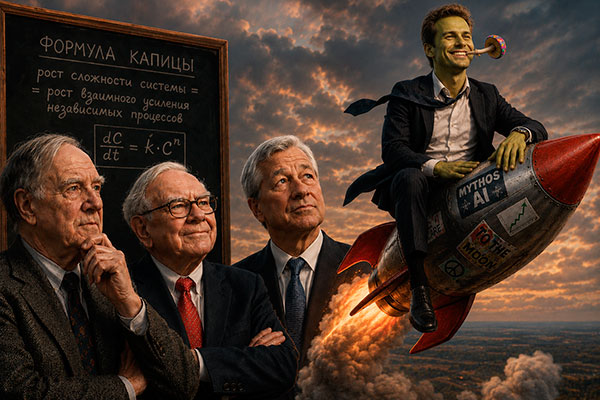
Warren Buffett and Jamie Dimon Have Once Again Confirmed Sergey Kapitsa’s Formula
Sources
Bloomberg | July 15, 2026
Jamie Dimon Warns About Broad Mythos Access, Calling It a Real Issue.
CNBC | July 15, 2026
Warren Buffett: It’s Tough to Find Values When Everybody Is Preferring Gambling.
Strange things sometimes happen to news. It is born in different offices, belongs to different people, speaks different languages, and then suddenly meets on the same page of the calendar, as though the stories had long known of each other’s existence. Only later does it become clear that they were not speaking to one another at all. They were speaking to the future.
On July 15, Warren Buffett and Jamie Dimon spoke almost simultaneously.
One is a man who has spent half a century teaching the world to buy businesses rather than beautiful stories about them. The other is the head of the world’s largest bank, watching every day as the nervous system of global finance changes before his eyes.
Buffett once again expressed a simple thought: true value becomes increasingly difficult to find when more and more market participants prefer not to invest, but to gamble.
Dimon was looking in an entirely different direction. His concern is no longer the market, but the human mind, now being handed tools capable of amplifying knowledge and delusion with equal speed. He described the broad availability of a new artificial intelligence model such as Mythos as a real problem and compared it to placing ballistic missiles in the hands of people who do not understand the power of what they possess. At the same time, JPMorgan is already using the system to test its own cyber defences, while hundreds of specialists work every day on its security.
Read separately, the two stories appear unrelated. One comes from the stock market, the other from the world of artificial intelligence. Yet the most important patterns are often born not in the substance of events, but in the moment of their arrival. Sometimes an era begins to speak in several voices at once.
It is precisely this kind of coincidence that would probably have interested Sergey Kapitsa. He viewed history as the behaviour of complex systems, in which real change does not occur because of a single event, but when independent processes begin to reinforce one another. It is at that moment that quantity quietly becomes quality.
Something similar is happening today.
Buffett is speaking about a market that increasingly resembles a casino, where the value of a business gives way to the speed of the bet. Dimon is warning about artificial intelligence capable of producing thousands of persuasive answers within seconds, among them conclusions that have never existed in reality. Developers call these artificial intelligence hallucinations — a term that, until recently, belonged almost exclusively to medicine. A machine can speak with such confidence that a person begins to doubt not the machine, but his own common sense.
This is where the two stories form a single picture. Imagine an investor who has long stopped reading financial statements, prefers charts, seeks not an understanding of the business but an answer to the question of which stock will rise tomorrow, and gradually delegates his own thinking to artificial intelligence. One convincing mistake is enough, one beautifully phrased hallucination — and the decision has already been made.
The danger does not arise simply because the market or artificial intelligence exists. It appears when excitement combines with credulity, and technology begins to multiply human weakness. This is precisely the effect Sergey Kapitsa described: independent processes reinforcing one another. The world is not changed by isolated events, but by processes that begin to accelerate each other until it becomes impossible to understand where human error ended and the error of the system itself began.
Andrievskii Verdict
Buffett is warning not so much about the stock market as about human nature, forever seeking easy money faster than knowledge. Dimon is speaking not so much about artificial intelligence as about the responsibility of the person into whose hands an increasingly powerful instrument has been placed.
Perhaps that is why their words were heard almost simultaneously. Not because some secret conversation existed between them, but because the era itself had decided to express one thought in two different voices.
Capital rarely dies from a lack of information. Far more often, it is destroyed by an excess of it, when a person stops doubting, checking and thinking independently. The most dangerous artificial intelligence hallucination is not born inside the algorithm. It appears at the moment when a person genuinely begins to believe that the algorithm is no longer capable of making mistakes. After that, it no longer matters whether the source of the illusion was the algorithm — or the mushrooms.
Aleksei Andrievskii | Advisory Board Member, Bendura Bank AG | Liechtenstein