Wall Street Lost $3.2 Trillion After the Democrats’ Midterm Win. AI Bets Took the Hit
ANDRIEVSKII.CH | November 6, 2026
U.S. stocks shed $3.2 trillion in market value in a single session. The Nasdaq 100 fell 6.4%, and the S&P 500 dropped 4.4%. Financial Times calculations based on FactSet data showed that the loss in market value across the broad S&P Composite 1500 was the largest since the turn of the century.
After Democrats won the midterms, Wall Street remembered that data centers have neighbors, lawmakers have voters, and construction projects have budgets. Some of the newly elected lawmakers had opposed new data centers. Investors worry that permits will take longer and that chip and server orders will come in later than forecasts assumed. Before the election, those same forecasts helped push stocks to record highs.
Chipmakers took the hardest hit. Nvidia fell 9.3% in a single session, shedding more than $400 billion in market value. A hedge fund manager told the Financial Times that large investors had started trimming their positions at the same time. Buyers, usually happy to pick up a bargain, decided to wait. Apparently, the discount looked suspicious precisely because it had finally arrived.
The selling had started before the election. Alphabet’s Class A shares fell 12.64% on October 29, and Intel dropped 28.6% the following day. By the November 5 close, Alphabet was 30.8% below its all-time intraday high. As Amundi’s Vincent Mortier noted, the post-election rally was short-lived. Questions about AI spending, regulation, and data center construction returned before the market had time to celebrate.
What Worked in Our Portfolios
While Wall Street was rethinking its AI bets, seven European stocks we hold for their defensive role gained about 12% on average in local currencies from the start of November. Air France–KLM rose 21.77%, Lufthansa 14.41%, Norwegian Air Shuttle 12.26%, Wizz Air 8.56%, Heidelberg Materials 16.62%, Holcim 7.08%, and Nestlé 2.99%.
Demand for air travel, building materials, and food follows different drivers. That makes the portfolio less dependent on when the next data center gets its building permit. Our portfolios have zero exposure to U.S. tech stocks. Even before the sell-off, I thought many of those valuations rested on overly generous earnings assumptions. Market memes did a fine job explaining why the stocks ought to go up. How much the companies would have to earn was usually left offscreen.
That question matters especially for the S&P 500. In February, Goldman Sachs estimated that a broad group of AI-related companies accounted for about 45% of the index’s market value. With that much concentration, falling valuations drag down the whole index. If investment in data centers and equipment falls alongside stock prices, the effects will reach beyond tech.
Currency diversification paid off in fixed income. A year ago, we made the Norwegian krone and Australian dollar our main currencies for that part of the portfolio. In the year to November 5, 2026, the krone gained 12.6% against the euro and 10% against the U.S. dollar. The Australian dollar rose 10.5% and 8%, respectively. Those currency gains gave open fixed-income positions an additional lift in euro-based portfolios.
Andrievskii Verdict
Until recently, you could go to lunch on Wall Street, fail to mention AI, and leave with a reputation for ignorance. Buy a stock over that same lunch without asking how much the company would have to earn to justify its price, and people admired your open mind.
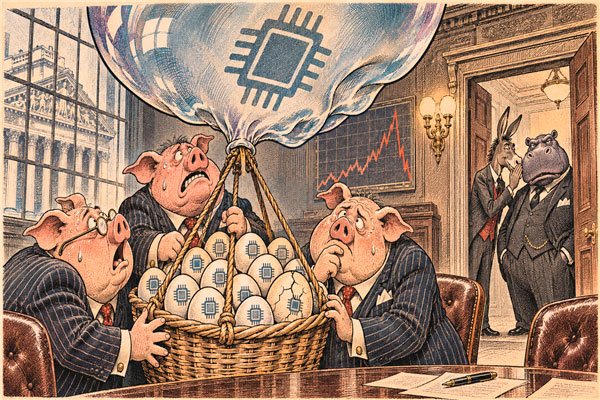
Diversification had gone out of fashion, too. Why spread your eggs across several baskets when one of them promises to be worth a trillion dollars? So people ended up with a dozen tickers. Each had a different logo. One reason was enough to bring them all down.
Well, one of the little pigs in this room has to die. Judging by the share prices, the first to go was the piglet already valued like an entire hog farm. And to think the password was “The donkey loves the hippo. Time to party.” Turns out it really is time to party. The band’s been paid. The feed bill is still coming.
Disclaimer: This publication is provided for informational purposes only and does not constitute personalised investment advice or a recommendation to buy or sell securities. Investments in financial instruments involve risks, including the potential loss of capital.
Aleksei Andrievskii | Advisory Board Member, Bendura Bank AG | Liechtenstein