Trump Tightens Defense Supply Chains, Targets China-Linked Critical Minerals
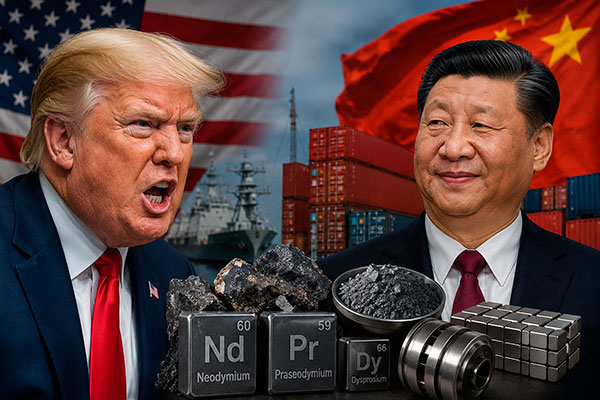
On the evening of July 20, U.S. President Donald Trump signed an executive order that significantly tightens requirements for defense contractors using critical minerals and other materials sourced from China and other prohibited foreign suppliers.
Source: www.whitehouse.gov
Companies will no longer be able to simply claim that a Chinese supplier was the cheapest or the only available option. To obtain a waiver, contractors will now have to demonstrate that they genuinely searched for alternative suppliers, disclose the origin of the materials they use, and present a detailed plan for eliminating prohibited supply chains.
At the same time, the Pentagon will conduct a comprehensive review of the entire strategic materials supply system, while the Department of Defense will receive additional tools to monitor compliance with the new requirements.
The reason is obvious. Despite years of efforts by Washington to reduce dependence on China, the U.S. defense industry remains critically dependent on Chinese supplies of rare earth elements, tungsten, graphite, antimony, and other strategic materials.
According to various estimates, China controls around two-thirds of global rare earth mining and nearly 90% of rare earth processing, remaining the key link in virtually every global supply chain.
White House adviser Peter Navarro described the new approach in the strongest possible terms:
"No more: 'We tried nothing and we're out of options.'"
Beijing, in turn, rejects Washington's accusations, arguing that its export restrictions are legitimate measures to protect national security.
Andrievskii Verdict
Reading this executive order, one gets the impression that behind its legal language lies a single question from Donald Trump:
"Why is America still unable to secure itself with strategic materials?"
In my view, this question should have been asked not in 2026, but many years earlier.
Building domestic mining capacity, rare earth processing, permanent magnet manufacturing, and other critical industries takes years, sometimes decades. Such supply chains cannot be created through a presidential executive order in a matter of months.
That is precisely why the most revealing aspect of this document is not its political rhetoric, but its substance.
Trump requires contractors to disclose the origin of virtually every strategic material, map their entire supply chain, and present plans to eliminate Chinese components. In addition, within 180 days the Department of Defense must submit a list of legal and contractual mechanisms that may be used against contractors and subcontractors that intentionally violate the requirements or deliberately mislead the government. This is no longer simply industrial policy—it marks the beginning of a comprehensive review of the entire U.S. defense supply chain.
But, in my opinion, the main conclusion lies elsewhere.
This executive order looks less like a demonstration of strength and more like an acknowledgment that a great deal of time has already been lost.
China spent decades building its mining industry, processing capacity, and the entire industrial ecosystem surrounding strategic materials. Today, the United States is effectively beginning this process from scratch while simultaneously trying to preserve its technological leadership in the defense sector.
The best example of this confrontation is the success of BYD.
The company benefits from access to relatively inexpensive Chinese lithium, permanent magnets, and other strategic materials, enabling it to compete with Tesla not only in technology but also in manufacturing costs. That is precisely why Washington's pressure on BYD appears entirely logical: for the United States, it is no longer just an automobile manufacturer, but one of the largest beneficiaries of China's industrial model.
My conclusion is simple. The upcoming inspections will most likely reveal systemic problems: insufficient oversight, weak coordination, chronic underfunding in key areas, and excessive dependence on external suppliers. This will inevitably lead to a redistribution of government contracts, the possible loss of licenses and security clearances for some contractors, and stronger government support for companies capable of building reliable domestic supply chains more rapidly. At the same time, global competition for rare earth deposits and other critical mineral resources outside the United States—particularly in Africa, Australia, and Latin America—is likely to intensify sharply.
Aleksei Andrievskii | Advisory Board Member, Bendura Bank AG | Liechtenstein