ANDRIEVSKII.CH | The U.S. Arsenal Is Being Depleted: The War with Iran Has Exposed an Extreme Shortage of Critical Minerals
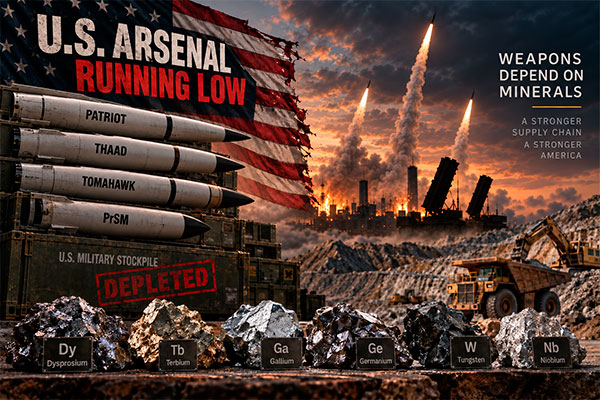
The depletion of U.S. weapons stockpiles during the war with Iran has revealed more than the cost of modern warfare. It has exposed a much deeper problem: America’s ability to replenish its arsenal quickly is increasingly dependent on the availability of critical minerals and the resilience of their supply chains.
Bloomberg Shows How Quickly the U.S. Arsenal Is Being Depleted
These estimates were presented in a special Bloomberg analysis published on September 16, 2026, under the headline “The Cost of the Iran Blockade Is Draining America’s Global Military Power.”
According to Bloomberg, of approximately 2,000 Patriot PAC-3 MSE missiles, around 1,200 have already been expended. For THAAD, the initial stockpile is estimated at approximately 527 interceptors, of which around 200 remain. For Tomahawk, approximately 1,000 missiles have been used from an initial stockpile of around 3,000. The situation with PrSM appears even more acute: around 100 missiles used out of approximately 112.
These are Bloomberg estimates, as the exact size of U.S. military stockpiles is classified.
But the more important issue is not the absolute numbers. It is the pace at which weapons are being consumed. The United States is simultaneously supporting an ongoing military operation and trying to rebuild its own depleted stockpiles.
And this is where a problem emerges that cannot be solved simply by increasing the defense budget.
The Cost of Replenishing the Arsenal
According to the Congressional Budget Office, U.S. Department of Defense spending related to the war with Iran reached approximately $38 billion by August 1, 2026. Of that amount, around $21.7 billion represents the estimated cost of replenishing expended munitions. Approximately $13.1 billion of that total relates to missile-defense interceptors, $7.3 billion to land-attack cruise missiles, and another $1.2 billion to other munitions.
The Congressional Budget Office also estimates additional spending of approximately $2 billion to $3 billion per month, depending on the intensity of the conflict. At the same time, replenishing some depleted stockpiles could take years rather than months.
But the financial cost is only half of the problem.
Even if Congress provides the necessary funding, that does not mean missiles will appear in storage depots within a few months. Production capacity, components, specialized materials, propulsion systems, explosives and skilled labor all impose their own constraints.
A modern missile does not begin on the assembly line of a defense contractor. It begins much earlier — in a mine, at a metallurgical plant, at a chemical-processing facility and at a factory producing specialized materials.
And this is where the war with Iran takes on an entirely different significance.
The Vulnerability Lies at the Beginning of the Supply Chain
Modern weapons production requires rare-earth elements, specialty metals, semiconductor materials and advanced alloys.
Dysprosium and terbium are used in permanent magnets and other high-technology applications. Gallium and germanium are important for semiconductors, optoelectronics and night-vision systems. Tungsten is used in materials designed to withstand high temperatures, wear and extreme loads. Niobium is used to strengthen steel and in specialized alloys.
That is why the United States Geological Survey classifies a number of these materials as critical minerals and identifies samarium, terbium, dysprosium, gallium, germanium, tungsten and niobium among mineral supply chains facing particularly high disruption risks.
This is no longer simply a commodity market.
It is the industrial foundation of national security.
Andrievskii Verdict
In my view, the war with Iran has demonstrated just how deeply modern defense depends on the raw-material base required to replenish weapons stockpiles quickly.
America can allocate tens of billions of dollars to rebuild its arsenal and expand the capacity of defense companies.
But money alone cannot create critical minerals. That requires deposits, mines, processing facilities and independent supply chains.
Therefore, I view the current depletion of the U.S. arsenal as a strong long-term argument in favor of critical minerals and the companies that produce them.
Aleksei Andrievskii | Advisory Board Member, Bendura Bank AG | Liechtenstein