Nestlé, the NBA and GLP-1: How Weight-Loss Drugs Are Rewriting the Rules of the Food Industry
ANDRIEVSKII.CH | October 8, 2026
The GLP-1 revolution is no longer just a pharmaceutical story. It is becoming one of the most powerful forces reshaping the global food industry. Nestlé’s historic partnership with the NBA offers another indication of how seriously consumer giants are taking this transformation.
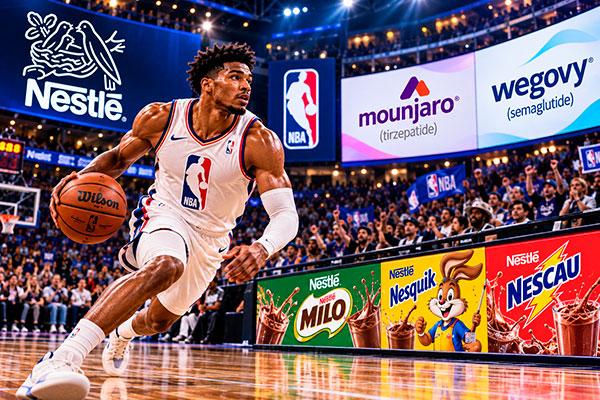
Swiss food giant Nestlé (SIX: NESN) has announced its largest international sponsorship agreement in history, partnering with the National Basketball Association across 21 countries on four continents.
The agreement will promote its Milo, Nesquik and Nescau brands, targeting younger generations increasingly focused on fitness, nutrition and healthier lifestyles.
But behind the basketball courts and marketing campaigns lies a much bigger story: the rapid expansion of GLP-1 weight-loss medications is forcing the food industry to reconsider what consumers will eat, drink and buy in the coming decade.
GLP-1: A Pharmaceutical Revolution With Economic Consequences
Drugs such as Novo Nordisk’s Wegovy and Eli Lilly’s Zepbound are changing more than waistlines. By reducing appetite and altering eating behaviour, they have the potential to reshape demand across entire categories of consumer products.
For decades, the food industry relied heavily on consumption volume, convenience and brand loyalty. GLP-1 therapies introduce a different economic equation: consumers may eat less while becoming more selective about nutritional value.
Protein, fibre, portion control and nutrient density are becoming increasingly important competitive factors.
Nestlé appears determined to adapt. Its partnership with the NBA connects established consumer brands with physical activity and nutritional positioning. Ali Abbas, head of Nestlé’s cocoa and malt beverages business, explicitly linked the strategy to the GLP-1 concept in comments to Reuters.
The initiative aims to encourage at least 2.5 million young people to become more physically active.
The Bigger Investment Picture
Nestlé is not alone. PepsiCo, Coca-Cola and Unilever are also expanding their sports partnerships as consumer preferences evolve.
However, the most important competition may no longer be between traditional food manufacturers. It may be between established consumption habits and an entirely new model of nutrition influenced by pharmaceutical innovation.
GLP-1 adoption creates both risks and opportunities. Manufacturers dependent on frequent snacking and high-calorie consumption face potential structural pressure. Companies capable of developing nutritionally focused products, smaller portions and specialised dietary solutions may discover new sources of growth.
Andrievskii Verdict
GLP-1 is gradually moving from a pharmaceutical breakthrough to a structural economic force.
Nestlé’s NBA agreement is a marketing investment, but its strategic significance extends well beyond sponsorship.
The food industry is beginning to recognise that the future consumer may simply need fewer calories — but demand more nutritional value from every calorie consumed.
The companies that understand this distinction early may be better positioned for the next decade.
And perhaps the most remarkable consequence of the GLP-1 revolution is that pharmaceutical companies are beginning to influence the business models of the world's largest food producers.
Disclaimer: This publication is provided for informational purposes only and does not constitute personalised investment advice or a recommendation to buy or sell securities. Investments in financial instruments involve risks, including the potential loss of capital.
Aleksei Andrievskii | Advisory Board Member, Bendura Bank AG | Liechtenstein