Lufthansa Dedicates Anniversary Livery to Employees’ Stories
ANDRIEVSKII.CH | October 30, 2026
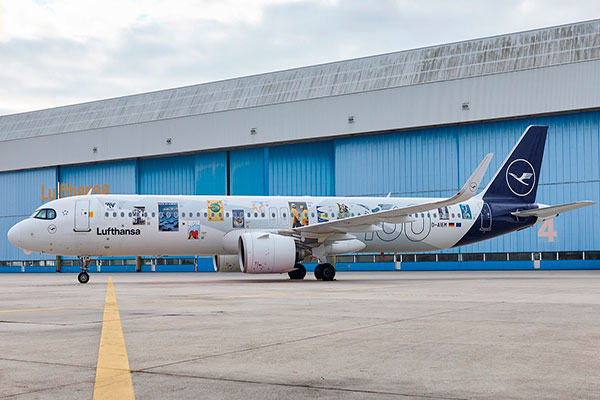
To mark the 100th anniversary of its founding, Lufthansa has created a special “Iconic Moments” livery for an Airbus A321neo. The design draws on 12 employee stories about work, travel, family traditions, friendship, and helping others. The airline introduced the people behind the project and the experiences that inspired their artwork in a feature published on October 30.
The stories include bringing stranded travelers home during the pandemic, flying scientists to the Falkland Islands for an onward expedition to Antarctica, opening an office in Dresden after the fall of the Berlin Wall, and meeting a future spouse on a flight to Vancouver. Through these experiences, Lufthansa highlights the people whose work connects generations and departments across the company.
An International Team
Flight attendant Lisa Katrin Young has worked for Lufthansa since 2010. For her, one of the profession’s greatest attractions is the opportunity to discover different cultures and meet new colleagues almost every working day.
Crew members usually gather around 90 minutes before departure. During that time, they discuss the upcoming flight and become a team that will share responsibility for the passengers. Young says this requires openness, tolerance, and a willingness to accept people as they are.
Even after 16 years in the profession, she remains struck by the trust that develops almost immediately. People who were strangers just a short time earlier are soon working together and sharing the crew rest area on a long-haul flight.
That sense of belonging inspired her artwork, “Dreaming the Same Dream.” It represents shared values alongside respect for each person’s individuality. Despite their differences, colleagues support one another and welcome passengers with the same openness.
The job has also influenced Young’s personal life. During stays abroad, she often joins excursions or short trips with colleagues she has never met before. These outings take shape in group chats, where someone might suggest a beach getaway or invite others to join a trip. For her, they offer another way to meet people and create lasting memories.
A Flight Home During the Pandemic
Flight attendant Sascha Behrens dedicated his design to a special flight to Bogotá in March 2020. At the start of the pandemic, Lufthansa worked with the German government to bring German travelers home from abroad.
On March 19, Behrens and the rest of the crew flew from Frankfurt to Colombia on an empty aircraft. After spending the night in Bogotá, they met passengers stranded at the airport. Some had been waiting seven days to return home. When the crew appeared, people applauded and cried with relief.
Behrens remembers the airport as almost deserted. He believes the Lufthansa aircraft may have been the only plane to depart from there that day. For a flight attendant who had been in the job for just a year and a half, the experience became one of the most powerful moments of his career.
It brought home to him that an airline’s role extends beyond taking people on vacation: it also helps them return to their loved ones in difficult circumstances.
Behrens’ artwork shows two arms embracing an aircraft’s tail fin. The image expresses his belief that aviation connects people and takes them to places where they feel at home.
New Opportunities After the Fall of the Wall
The story of Bettina Streich, a Key Account Manager in Lufthansa’s leisure sales business, is closely connected to German reunification.
In June 1990, just months after the fall of the Berlin Wall, the 24-year-old moved from North Rhine-Westphalia to Dresden. There, she helped establish one of Lufthansa’s first city offices. That same year, she attended the reunification celebrations at Berlin’s Brandenburg Gate.
She remembers Dresden as a city anticipating change. Reconstruction of the Frauenkirche was only beginning, and the freedom to travel held particular significance for local residents. By selling airline tickets, Lufthansa employees became part of that transformation.
Streich headed the ticket counter and reservations team and trained local staff. One particularly memorable moment came when the company offered new employees free tickets for a weekend trip to a destination of their choice. Almost everyone chose Sydney—for just three days. For Streich, the journey captured the spirit of the time and the desire to see the world.
Mutual support within the team was equally important. She says the habits of helping, sharing, and exchanging necessities that shaped daily life for many East Germans carried over into working relationships. She remains in contact with some of those colleagues today.
Her artwork is titled “Beyond Yesterday’s Borders, Toward New Horizons.” It depicts colorful figures, representing diversity, walking hand in hand into the future in front of the Brandenburg Gate. The image also draws on the Scorpions song “Wind of Change,” one of the musical symbols of that era.
A Family History in Aviation
For Sabine Wingold, Lufthansa has been part of family life since childhood. Her mother worked in aviation insurance at the company’s Hamburg base, while her father inspected engines and turbines at Lufthansa Technik. From an early age, Wingold traveled and encountered other countries and cultures.
In 1999, she began training as an aircraft engine mechanic at Lufthansa Technik. There, she met colleagues she had previously heard about from her parents. What united them was their enthusiasm for the profession—the same quality she now sees in younger employees.
Wingold worked as a mechanic for 24 years before moving into the VIP area. Her technical career also included international assignments. On one project, she spent ten days in Phoenix, Arizona, helping assemble a new auxiliary power unit for the Airbus A350. She says she was the first mechanic in the world to receive the relevant training.
Her contribution to the anniversary livery is called “To Move with the Times.” Through it, she sought to show how the airline and the wider world have changed, how closely countries are connected today, and how people from different parts of the globe can work together.
She sees employees as central to those changes, with their ideas and commitment underpinning Lufthansa’s development.
Stories Under a Shared Sky
Flight attendant Pia Eutin titled her design “Many Stories, One Sky.” It brings together puzzle pieces, people, and small aircraft against a bright background. For her, the puzzle represents the experiences, beliefs, and encounters that shape an individual.
Eutin wanted to create a positive, emotional image. Blue and yellow reference Lufthansa’s colors, while soft pastel shades convey lightness, openness, and human connection.
Before joining the airline, she worked in hospitality and spent several years at Düsseldorf Airport. She began her flight attendant training at the end of 2024 and now mainly operates long-haul flights from Munich to North America and Asia.
The idea of a shared sky grew from observing passengers. Some are traveling on their honeymoon, others are experiencing a farewell, and others are flying to visit relatives. Each has a different story, but the sky above them is the same, regardless of the distance between them.
She sees that same sense of connection within the crew. Colleagues often meet for the first time shortly before a flight, yet each brings experience that contributes to their work together.
One encounter that particularly stayed with her involved an elderly couple traveling to meet their grandchild for the first time. Moments like that became the emotional foundation of her artwork: Eutin wanted to convey both diversity and the warmth of human relationships.
A Lufthansa Flag in Antarctica
Senior Project Manager Jörg Pelger drew inspiration from a photograph of a Lufthansa flag in the Antarctic ice, published on the company’s intranet. For him, the image symbolized teamwork in a place almost uninhabitable for humans.
The story began on January 31, 2021, when the Airbus A350-900 “Braunschweig” departed Hamburg for the Falkland Islands. At 13,700 kilometers, the journey was Lufthansa’s longest nonstop flight at the time.
On board were scientists from the Alfred Wegener Institute and crew members of the research vessel Polarstern, who would continue to Antarctica. The flight took place during the pandemic and required strict quarantine measures.
It was one of two special flights Lufthansa operated for the institute. The mission was led by Captain Rolf Uzat, who has since passed away. For many participants, the operation became an example of solidarity and social responsibility during a period of uncertainty.
Through internal updates, the crew shared the journey with colleagues. Pelger says that, at a time when many employees were on furlough, the mission reminded them that the company was still needed and fulfilled responsibilities beyond routine transport.
Captain Felix Döllefeld, who took part in the flight, recalled colleagues back home asking the crew to keep them in mind. The crew felt that connection throughout the mission.
The trip also brought an unexpected reunion: Döllefeld met Carsten Zillgen, a helicopter pilot and flight operations manager aboard Polarstern. They had served together in the German Armed Forces but had not seen each other for around 30 years.
To commemorate the operation, the crew and scientists signed a Lufthansa flag. Zillgen later took it on helicopter flights and photographed it in the Antarctic ice. The flag is now displayed at Hangar One at Frankfurt Airport.
For the anniversary project, Pelger adapted the photograph to emphasize the mission’s shared purpose. His design celebrates mutual support, responsibility, and people’s ability to solve difficult challenges together.
The People Who Make Flying Possible
Yonca Rojda Dursun, who works in Leadership & Talent Development, depicted several hands jointly supporting an aircraft fuselage. She wanted to highlight the contribution of employees whose work often remains behind the scenes.
The hands represent cooperation, trust, and shared responsibility. The design does not single out one profession: pilots, flight attendants, mechanics, ground staff, cargo teams, and many other departments all contribute to the airline’s operations.
In her daily work, Dursun develops talent management programs for the Lufthansa Group. Together with colleagues across departments, she helps identify employees with potential and supports their professional development.
That experience shaped her design: people from different generations, professions, and management levels collectively support the company. The hands therefore deliberately lack symbols linking them to particular roles or ranks.
Dursun wanted the image to be simple and understandable without further explanation. She also sought to recognize employees outside flight operations, as well as those who have left the company or passed away but remain part of its history.
She sees the artwork’s inclusion on the aircraft as recognition of that wider community’s contribution.
Meeting on a Flight to Vancouver
Annette and Dennis Poyda’s story began in 2016 on a flight from Munich to Vancouver. Both were flight attendants at the time and barely knew each other.
The day after arriving, they joined four colleagues on a skiing trip to Whistler. The group planned to return by seaplane, which would land near the crew hotel, but the flight was canceled because of the weather.
They stayed longer in Whistler before driving back to Vancouver, stopping at scenic viewpoints and taking short walks along the way. That evening, they had dinner together and later met by the hotel pool. Dennis recalls that this was when they really got to know each other.
They continued seeing each other after returning to Munich, and their friendship gradually became a relationship. Five years later, Annette and Dennis married.
Dennis’ career also changed during that time. He trained as a pilot, worked for Lufthansa CityLine for five years, and then moved to Lufthansa. Annette continues to work as a flight attendant. Occasionally, their schedules put them on the same aircraft—so far, this has happened twice, on flights to Stockholm and Porto.
A love of nature and a shared passion for aviation brought them together. Their “Iconic Moments” artwork therefore shows them skiing in the mountains, recalling the trip that marked the beginning of their life together.
“100 Years—One Family”
Andreas Spiewak, Torsten Susemihl, and Panagiotis Hatzizelidis, employees at Lufthansa Technik’s paint shop in Hamburg, created an image of two interlocking hands. Within them are figures representing a mechanic, a pilot, and a flight attendant, alongside aircraft components such as landing gear and an engine.
The design is titled “100 Years—One Family.” It reflects the artists’ daily experience: every aircraft depends on specialists with different skills working together.
For the three employees, “family” also has a literal meaning. Susemihl has worked at Lufthansa Technik for more than 40 years, and his daughter has now joined the team. Hatzizelidis has been with the company for 32 years, and both his sons work there. Spiewak joined Lufthansa Technik four years ago.
The opportunity to develop their own concept particularly appealed to them. They met several times after work, sketched ideas on paper, and then completed the design on a computer.
The artwork is being transferred to the aircraft with minimal changes. Positioned near the entrance, it will make boarding through that door a special moment for its creators.
Source: www.lufthansa.com
Aleksei Andrievskii | Advisory Board Member, Bendura Bank AG | Liechtenstein