Heidelberg Materials: The Company Selling What the Future Cannot Be Built Without
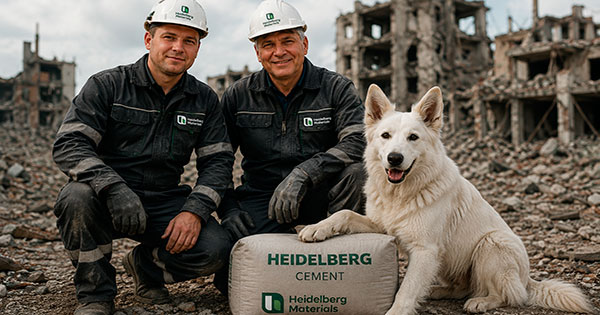
Why some of the world's largest investors continue to accumulate shares of Germany's building materials giant.
The stock market has one amusing habit. From time to time, it begins to believe that humanity has learned how to live without the most ordinary things.
During such periods, investors enthusiastically discuss new technologies, digital platforms and revolutions that are supposed to change the world by the next quarter. Then someone suddenly reminds them that people still need roads, bridges, houses, ports, factories and power stations.
And then it turns out that concrete has not yet been cancelled.
Perhaps this is why shares of Heidelberg Materials continue to be held in the portfolios of the world’s largest investment houses. BlackRock, Capital Group, Fidelity, Vanguard and other institutional investors own significant stakes in the German building materials giant. The largest shareholder remains German entrepreneur Ludwig Merckle, who controls around 28 percent of the company through his investment structure.
It is also interesting that Heidelberg Materials itself is actively buying back its own shares under a share buyback programme of up to €1.2 billion.
Usually, a company knows better than anyone else what is happening inside its own business. So when management prefers to buy shares rather than tell beautiful stories, investors tend to pay attention.
Heidelberg Materials is not an easy company to call fashionable.
It does not promise to change the world at the push of a button. It does not sell dreams of digital immortality. It does not claim that artificial intelligence will soon replace a cement plant.
It simply produces the materials from which modern civilisation is built.
Today, Heidelberg Materials is one of the largest producers of building materials in the world. The company operates in almost fifty countries, manages thousands of production sites and holds leading positions in cement, concrete and aggregates.
There is another feature of global business that is rarely mentioned in advertising brochures.
When a European investor buys shares in a cement producer, he usually imagines neat factories somewhere in Germany and annual reports with beautiful sustainability charts. Reality is a little more interesting. Modern trade in building materials still resembles the old Mediterranean world, where one port rarely knows the full route of the next ship.
Heidelberg Materials controls around 79 percent of Akçansa, one of Turkey’s largest cement producers. Turkey has long been a natural bridge between Europe, the Middle East and the Eastern Mediterranean. Through such regional hubs, large volumes of building materials move onward to markets across the region.
In international business, this is considered perfectly normal. Large corporations prefer to work through strong local partners and subsidiaries, gaining access to regional demand without having to manage every truck and every ship from headquarters in Heidelberg.
That is why investors should sometimes remember that cement can travel much farther than one might expect from such a heavy product.
Several years ago, the company’s management decided that even a cement producer had the right to a second youth. That is how HeidelbergCement became Heidelberg Materials.
But the change of name was followed by something more serious.
The company is actively investing in carbon capture technologies, recycling of construction waste, alternative fuels and new materials with a lower carbon footprint. In other words, it is trying to prove that even one of the most conservative industries can change with the times.
But there is another reason why long-term investors are watching the company closely.
Sooner or later, Europe will face the largest infrastructure reconstruction programme since the Second World War. When that moment comes, the world will not need beautiful presentations or fashionable forecasts from analysts.
It will need millions of tonnes of cement.
Cities will have to be rebuilt brick by brick. Roads — kilometre by kilometre. Bridges — span by span.
At such moments, the market usually remembers that the foundation of a building is more important than the brochure of the construction company.
Thanks to its plants in Germany, Poland, the Czech Republic, Romania and other countries in the region, Heidelberg Materials already has the production and logistics infrastructure that could play an important role in a future construction cycle in Eastern Europe.
If we add the potential growth in demand for building materials in the Middle East, where Turkish producers have traditionally held strong positions, the picture becomes even more interesting.
Perhaps this is why the world’s largest investors continue to show interest in the company.
Big money rarely bets on tomorrow’s newspaper headline.
It prefers to own what the world will still need ten years from now.
Andrievskii Verdict
History shows that civilisations are built not on forecasts, but on materials.
Investors love to talk about the future. But when the future finally arrives, for some reason it always needs concrete, cement, roads and bridges.
And until humanity learns how to build cities out of PowerPoint presentations, Heidelberg Materials is unlikely to go out of fashion.
Aleksei Andrievskii | Advisory Board Member, Bendura Bank AG | Liechtenstein