ANDRIEVSKII.CH | Eli Lilly and Novo Nordisk: From Weight Loss to Protecting the Heart, Brain, and Kidneys
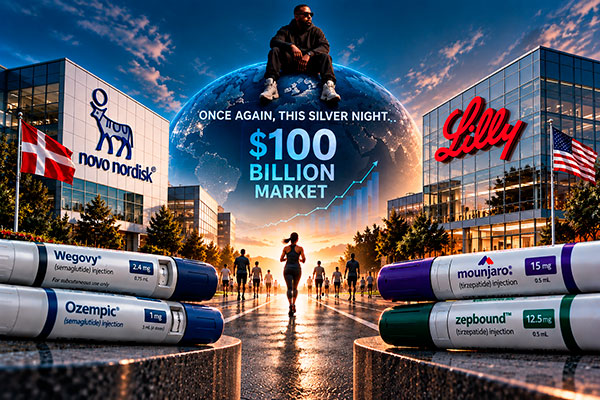
Just a few years ago, weight-loss drugs were viewed as a promising but niche segment of the pharmaceutical industry. Today, they have become one of the fastest-growing areas in global healthcare, while the rivalry between Eli Lilly and Novo Nordisk has evolved into one of the defining investment stories of the decade.
Forecasts suggest that global obesity drug sales could exceed $100 billion annually by 2030. In February 2026, Reuters reported that Goldman Sachs projected sales of $105 billion by that date, down from an earlier estimate of $130 billion as expectations for prices weakened.
Obesity is no longer regarded simply as a matter of excess weight. It is now recognized as a chronic disease that significantly increases the risk of type 2 diabetes, cardiovascular disease, chronic kidney disease, and numerous other serious health conditions. For pharmaceutical companies, this represents the prospect of sustained long-term demand. For investors, it has become one of the most closely watched long-term opportunities in healthcare.
Novo Nordisk: The Case for a Comeback
In an August 2026 interview with Reuters, Novo Nordisk Chief Executive Officer Mike Doustdar offered investors a different perspective on the company's rivalry with Eli Lilly: the obesity drug market will not be a winner-takes-all business.
According to Doustdar, demand is expected to become so vast that several global companies will be able to thrive simultaneously. Much like the insulin market, physicians and patients will choose therapies based on efficacy, safety profiles, ease of use, and overall treatment value. As a result, Novo Nordisk's strategy extends beyond developing new molecules. The company is also focused on expanding the market itself, particularly through the development of oral therapies.
That strategy is already taking shape. Novo Nordisk has launched the tablet version of Wegovy in Germany while continuing to expand clinical development of oral semaglutide. Oral treatment could attract patients reluctant to use weekly injections, expanding the addressable obesity market.
Despite intensifying competition, Novo Nordisk retains a substantial business. In its 2025 annual report, the company reported a 59.6% share of the global branded GLP-1 obesity market by volume, while revenue from its Obesity Care division increased 31% at constant exchange rates, reaching DKK 82.3 billion. The market-share figure reflects the reporting period covered by the 2025 annual report; it is neither a current market-share estimate nor a measure of revenue share.
That figure also reflects the global landscape rather than the competitive dynamics of individual markets. In the United States—the world's largest obesity drug market—Zepbound has overtaken injectable Wegovy in weekly prescriptions. However, Novo Nordisk reported that the broader Wegovy franchise, including the pill, led branded obesity medicines by new patient starts in its second-quarter 2026 update. Novo Nordisk also maintains an established presence across Europe and other international markets. As a result, identifying a single market leader requires specifying the geography, product grouping, reporting period, and performance metric being analyzed.
At the same time, Novo Nordisk continues to broaden the clinical potential of semaglutide. In company-reported initial results from STEP Young, an analysis estimating outcomes if all participants adhered to treatment found that 40.4% of children aged six to under twelve receiving semaglutide achieved a BMI below the obesity threshold after 68 weeks, compared with none receiving placebo. Both groups also received lifestyle intervention. The findings could support a future expansion of approved indications, subject to regulatory review.
Conversely, following the failure of the ZEUS cardiovascular study, Novo Nordisk discontinued two additional ziltivekimab trials in patients with heart failure. The setback highlighted the challenges the company faces in building another growth platform beyond its GLP-1 franchise.
Investor sentiment toward Novo Nordisk has changed markedly over the past two years. Once viewed as the undisputed leader in obesity treatment, the company is now being evaluated on the speed of its product innovation, the strength of its next-generation pipeline, and its ability to defend market share against Eli Lilly's rapid advance. Those factors are likely to define the next phase of competition in a market that is already reshaping the global pharmaceutical industry.
Eli Lilly: The Company That Rewrote the Rules of the Game
Eli Lilly's defining advantage is tirzepatide, marketed under the brands Mounjaro and Zepbound. In the head-to-head SURMOUNT-5 trial involving adults with obesity but without diabetes, tirzepatide produced greater average weight reduction than semaglutide after 72 weeks. The trial compared maximum tolerated weekly doses of 10 or 15 mg of tirzepatide with 1.7 or 2.4 mg of semaglutide. That clinical edge has contributed to commercial success, alongside factors such as treatment access, tolerability, and patient preference.
The financial results reflect that momentum. In the second quarter of 2026, Mounjaro generated $9.94 billion in revenue, a 91% year-over-year increase, while Zepbound contributed another $4.93 billion. Together, the two products accounted for 64.7% of Eli Lilly's quarterly revenue, and the company raised its full-year 2026 revenue guidance to $85–87 billion. These combined product sales include diabetes and obesity indications, rather than obesity treatment alone.
Eli Lilly had already become the first pharmaceutical company to reach a $1 trillion market capitalization on November 21, 2025. That milestone preceded its second-quarter 2026 results and reflected investor enthusiasm for the company's expanding obesity and diabetes business.
Competition, however, is no longer limited to injectable therapies. Foundayo (orforglipron), Lilly's oral obesity treatment, received FDA approval on April 1, 2026, and became available in the United States on April 9. The company is also advancing retatrutide, a next-generation investigational therapy for obesity and metabolic disease. At the same time, Lilly continues to invest heavily in manufacturing capacity to meet growing global demand.
Growth, Competition and Investor Expectations
Today, Eli Lilly benefits from exceptional growth and strong financial performance. For investors, the question is how much of its future success is already reflected in its valuation.
Novo Nordisk, by contrast, has endured a more challenging period. Intensifying competition, mixed results from the CagriSema program, a change in leadership, and a sharp decline in its share price have all weighed on investor sentiment. Yet the company's underlying business remains substantial.
For both companies, a growing patient population does not guarantee proportionate earnings growth. Insurance coverage and affordability influence access to treatment, while realized prices and the costs of manufacturing and distribution determine how much revenue becomes profit. Wider adoption can therefore coexist with pressure on margins.
For Novo Nordisk, recovery will depend on whether new products can generate additional demand and restore sustained earnings growth despite competitive and pricing pressure. For Lilly, investors must assess whether future performance can justify the valuation they pay today.
Andrievskii Verdict
Today, Eli Lilly's commercial momentum appears well deserved. The company combines rapid growth, a highly successful product portfolio, and a strong position in the US injectable obesity market.
Yet investment opportunities are determined not only by business quality, but also by how much future success is already reflected in a company's valuation.
From that perspective, Novo Nordisk presents a contrarian investment case. Its established business and prospects for product-led recovery warrant attention, although they do not, by themselves, establish that the shares are undervalued.
Doustdar's central message is straightforward: the obesity treatment market will not produce a single winner. Instead, its growth will be driven by expanding patient populations, new drug formulations, and broader clinical indications.
If that vision proves correct, competition between Eli Lilly and Novo Nordisk will evolve beyond a battle for market share. It will become a race to expand access to obesity treatment worldwide—one in which long-term success depends on reaching new patients as well as competing for existing demand. For shareholders, the decisive test will be how effectively each company converts that opportunity into durable earnings.
Aleksei Andrievskii | Advisory Board Member, Bendura Bank AG | Liechtenstein