EasyJet Raises the Stakes: The Repricing of European Airlines Has Begun
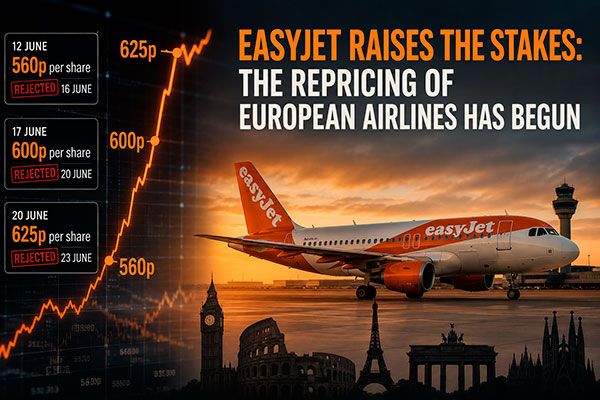
Three Bids, Three Rejections
Castlelake's pursuit of easyJet has rapidly evolved into a high-stakes takeover battle. On 12 June, the U.S. investment group submitted its first indicative proposal at 560p per share, which the board rejected on 16 June. A second proposal at 600p followed on 17 June and was rejected on 20 June. Castlelake then returned with a third offer of 625p per share, valuing easyJet at approximately £4.7 billion, which the board rejected on 23 June, arguing that it fundamentally undervalued the airline and its prospects. According to several major shareholders, meaningful negotiations would probably begin only if the offer exceeded £7 per share, implying a valuation above £5.3 billion.
The numbers themselves matter less than what they reveal.
For years, European airline shares have traded as though investors were pricing only risks. Yet when a sophisticated financial buyer begins evaluating the same companies, the analysis usually starts with something far less emotional: the replacement value of aircraft, ownership of airport slots, maintenance infrastructure, holiday businesses, loyalty programmes and future cash generation.
That calculation often produces a very different answer.
Barclays analyst Andrew Lobbenberg recently estimated that easyJet's underlying asset value could reach as much as £11.35 per share—more than double where the stock traded before Castlelake's approach became public. Whether that precise number ultimately proves correct is almost secondary. The more important point is that institutional investors are openly questioning whether the public market has materially undervalued the company.
Once strategic or financial buyers signal that a listed airline is worth substantially more than its market price, every undervalued carrier effectively goes "on sale." Investors immediately begin asking not only what the business is worth—but who might want to own it. That is often how a single takeover approach evolves into a sector-wide re-rating.
Strategic and financial buyers have historically recognised value long before public markets have been willing to acknowledge it. Once a credible bidder demonstrates that airline assets justify substantially higher prices than current market valuations imply, every comparable company comes under fresh scrutiny.
Suddenly, low-cost carriers stop looking like cyclical trading vehicles and begin to resemble strategic infrastructure businesses.
Ironically, Castlelake may end up buying nothing at all.
Its greatest achievement may not be acquiring easyJet, but forcing investors across Europe to reconsider what airline businesses are actually worth. Sometimes the most important takeover is the one that never happens, because it changes the valuation of an entire industry.
If bidding pressure continues to build, the implications will extend far beyond one British carrier. The market may soon begin revaluing Europe's listed airlines as a whole—and companies such as Wizz Air, Norwegian Air Shuttle and other listed low-cost carriers could find themselves viewed through a very different lens.
Andrievskii Verdict
The proposed acquisition of easyJet is not simply another corporate transaction—it is a catalyst. Every successive bid has raised more than the price of one airline; it has raised the market's expectations of what European airline assets may truly be worth. If Castlelake returns with a higher offer—or if another bidder enters the process—the repricing is unlikely to stop with easyJet. It could become the moment investors began reassessing the entire European airline sector.
Aleksei Andrievskii | Advisory Board Member, Bendura Bank AG | Liechtenstein