China extends pause on critical materials export curbs to the US until 27 January
ANDRIEVSKII.CH | November 25, 2026
China’s lead in processing strategic materials gives Beijing leverage in its negotiations with Washington.
China has extended its suspension of certain export restrictions on critical materials bound for the United States until 27 January 2027. The Ministry of Commerce announced the decision on 24 November, days after Xi Jinping and Donald Trump met in Shenzhen. The previous suspension was due to expire on 27 November. The extension covers gallium, germanium, antimony and certain dual-use superhard materials. Beijing has also deferred tighter checks on the end users and intended uses of US-bound graphite shipments. Existing export licensing requirements remain in place.
Beijing introduced the US-specific curbs in December 2024 after Washington tightened restrictions on shipments to China’s semiconductor industry. China suspended the measures in November 2025 under a trade truce agreed after the two leaders met in South Korea. As the Financial Times reported, the latest extension came as a surprise. Days earlier, Washington had tightened controls on advanced chip exports to China, prompting Taiwanese and South Korean manufacturers to suspend some shipments to Chinese customers. Beijing warned of possible retaliation but has kept the suspension in place for now.
There are two January deadlines. A separate suspension covering a package of measures that includes rare-earth export controls expires on 10 January. The pause on US-specific restrictions for several critical materials runs until 27 January. Before the November summit, Washington had already questioned China’s compliance with its commitments on rare-earth exports. Beijing has considerable leverage here. The International Energy Agency estimates that China accounted for about 85% of global refining of magnet rare earths in 2025.
Japan illustrates how differently the truce can look outside the United States. Japanese officials told the Financial Times that the Trump–Xi meetings had done little to improve access to key rare-earth materials for Japanese buyers and that enforcement had, in their view, grown tighter. Officials in Tokyo have warned that stocks of yttrium, used in gas turbines and semiconductor manufacturing, could run low within months unless alternative suppliers can make up the shortfall.
Andrievskii Verdict
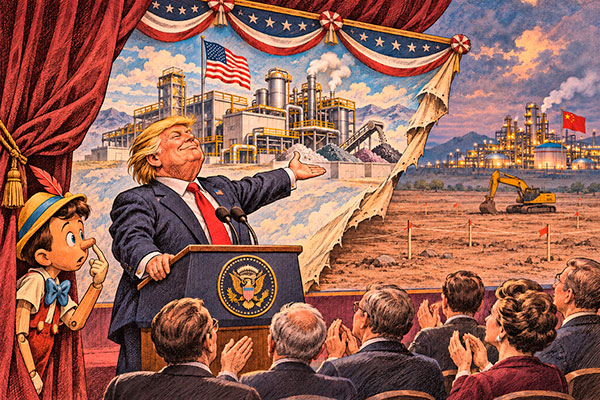
Had Pinocchio been watching from the wings when Donald Trump addressed mining executives on 7 August, he might have wondered why his nose hadn’t grown an inch. That day, at the State Department, the administration announced more than $2 billion in mining and related projects and deals. It was an impressive sum. A rare-earth separation plant, however, has the tiresome habit of opening only after someone builds it.
Washington faces an awkward choice. Chips and artificial intelligence have become a major driver of the US equity market. J.P. Morgan Asset Management calculates that a basket of 54 AI-related stocks accounted for 54% of the S&P 500’s price gains from January 2024 to early November 2026. If Washington wants predictable access to Chinese rare-earth supplies, Beijing may ask for concessions precisely where America is accustomed to setting the terms: advanced chip exports. The price of a deal could be a weaker American grip on access to those technologies.
China’s position reminds me of De Beers at the height of its influence. Rare-earth deposits exist well beyond China, but Beijing has spent decades building the capacity to concentrate, separate and refine them. Washington wants to persuade China that this supply chain can be recreated quickly. The August announcements put several projects on the table, but the funding still looks modest beside the scale of the job. Unless those commitments lead to financed construction and long-term purchase contracts, the industry risks losing investors just when it needs their capital most.
For now, both sides are extending deadlines, and a broader deal has yet to take shape. By 27 January, I would look for one of two signs of real movement. Either Trump makes substantial concessions on chips in exchange for more dependable access to Chinese materials, or Washington shows which mines and processing plants will get the money to build and who will commit to buying their output. Those two months are already on the diplomatic calendar. I would quite like to see them on a construction schedule.
Disclaimer: This publication is provided for informational purposes only and does not constitute personalised investment advice or a recommendation to buy or sell securities. Investments in financial instruments involve risks, including the potential loss of capital.
Aleksei Andrievskii | Advisory Board Member, Bendura Bank AG | Liechtenstein