Bendura Bank CEO: “We want to double in size”
ANDRIEVSKII.CH | November 13, 2026
CEO Philipp Forster discusses serving clients in 20 languages, the bank’s Hong Kong owner and its target of CHF 6.5 billion in client assets by 2030.
There are several reasons to visit Bendura Bank in Bendern, a short drive from Vaduz. The first is the headquarters itself, a striking modern building in red brick and glass, recently enlarged with an extension. A particular highlight is the new boardroom and adjoining lounge and bar, whose cosy atmosphere, in shades of brown and ochre, is hard to match.
Then there is the international structure of the bank itself. Hong Kong’s Citychamp Watch & Jewellery Group has been its principal shareholder for just over a decade, a milestone the bank recently marked with a ceremony.
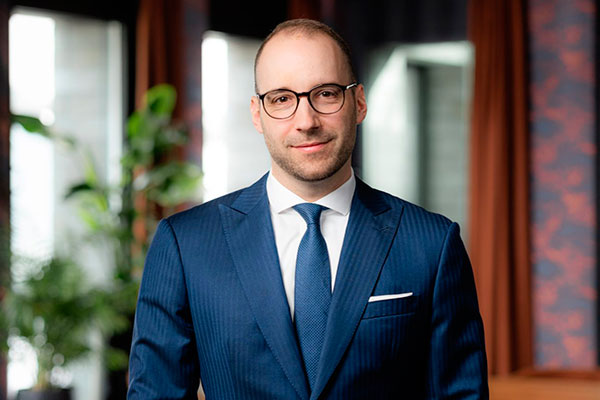
And then there is Philipp Forster. The man who built the bank’s now profitable Hong Kong business has been CEO since the beginning of 2025. In his first year in office, the bank impressed with CHF 550.2 million in net new money, and assets under management rose 17 per cent year on year to CHF 4.07 billion. The year 2026 also got off to a promising start. According to the bank’s half-year report, client assets grew to CHF 4.6 billion, with net new money of CHF 288.7 million.
Mr Forster, if you were at a cocktail party and someone asked you what Bendura Bank does, what would you say?
We’re a Liechtenstein bank, licensed here in Liechtenstein. We provide financial services to wealthy private clients, entrepreneurs, their families and their advisers. Our markets stretch from Central Europe, where we have our headquarters in Liechtenstein, to Hong Kong, where our office covers the Asian markets. We also serve selected markets along the route between the two.
So, classic private banking?
Classic private banking with a very strong international focus. Our approach is to serve clients in their native language. We currently offer more than 20 languages in-house. That’s partly about language itself, but it’s also very much about understanding the culture of each market. Clients get that understanding along with access to the stability and security of Liechtenstein as a banking centre.
“A client will never end up on a helpline where nobody knows them.”
Which languages matter most?
It starts with German and English and extends into Eastern Europe — Poland is a particularly strong market for us — and on to the Balkans and the Middle East. Turkey is another strong market. Then there’s Mandarin and Cantonese. Financial matters can be highly emotional. Clients simply feel more comfortable discussing them in their own language.
How many relationship managers do you have?
We have 30 relationship managers in all. They work in teams with experienced assistants, so our clients always have someone they know to turn to and receive individual attention. A client will never end up on a helpline where nobody knows them.
The bank manages CHF 4.6 billion in client assets. How does that break down geographically?
If you look at the end clients, roughly half of the business comes from Central Europe. The other half is our international business in Eastern Europe, Central Asia and Asia.
What role do external asset managers, fiduciaries, foundations and trusts play?
Asset managers who manage clients’ accounts directly account for about 20 per cent. But we take a broader view of what an intermediary is. We work with all of a client’s trusted advisers, including their external asset manager, lawyer or tax adviser. Fiduciaries and structuring are very important to us. Liechtenstein has long been known for its foundations, and it’s our home market. We work with virtually all the fiduciaries here, particularly when international clients come to us with needs that span languages and cultures.
Client deposits account for more than 90 per cent of your balance sheet. Are you more in the business of holding cash than managing wealth?
You have to distinguish between what’s on the balance sheet and what’s off it. Of the CHF 4.6 billion, just under CHF 2 billion is on the balance sheet. The rest is invested in securities portfolios. Cash currently accounts for about 45 per cent of total assets under management. There are two reasons for that. Our clients are entrepreneurs who take risks in their home countries. The portion they invest with us tends to be the conservative, safe part that they keep close to cash. The second reason is that it depends heavily on interest rates. Around 60 per cent of our client deposits are in US dollars, where rates are relatively high. If you can earn 3 to 3.5 per cent on a term deposit, a lot of money goes into term deposits. During the period of zero interest rates, though, we saw how quickly that money could move off the balance sheet and into securities portfolios and equities.
Would you like to reduce that share and encourage more clients to take up investment mandates?
We offer discretionary and advisory mandates, and part of our strategy is to increase take-up. We’ve also just won an award for our investment process. Many of our clients already work with external asset managers, though. We don’t want to take business away from our partners. Where it makes sense, we do want to help clients move cash into wealth management products.
Your mortgage book has shrunk considerably. Are you pulling back?
One large loan matured. If you strip that out, the book actually grew slightly. We’re very selective about mortgages. We lend only in German-speaking markets and only where there’s a private banking relationship as well. We do less standalone financing for single-family homes. Most of the properties we finance are luxury homes in the CHF 5 million to CHF 15 million range. We don’t want growth at any price. The book is relatively small, so one large loan maturing makes a bigger difference in percentage terms. That’s consistent with our conservative approach.
You earned around CHF 4 million from other services in the first half. What does that consist of?
Those are fees for payments, account maintenance, account opening and administration. They’ve settled at about that level. We serve international corporate structures. We’re the wrong bank for a company’s day-to-day operations, but we do look after private individuals and holding structures. When operating companies make distributions and cash is allocated within a group, we handle that.
Payments are generally seen as a commodity. How do you make money on them?
It’s the complexity. We’re talking about international payments across jurisdictions and currencies, involving foreign exchange transactions and the compliance work that goes with them. That’s a different proposition from local payments within Europe, and it’s a service we can charge for.
Why does a Hong Kong watch and jewellery group own a Liechtenstein bank?
For the owner, it’s very clearly about diversification. The holding company started out in real estate and entered the watch business in China. It later expanded into Switzerland and diversified into several industries, including financial services. The owner has no operational involvement. It is represented on the board and sets the strategic direction, but the business is run here in Liechtenstein. It’s important for us to have a stable shareholder with a long-term commitment. We’ve just celebrated the tenth anniversary, and the message was clear. This is a long-term investment. The shareholder can also open certain doors for us in Asia.
How is your Hong Kong operation set up?
There are two parts to it. We’ve had a representative office since 2018. It doesn’t book client funds. We open the accounts in Liechtenstein. The office raises our profile, handles marketing and puts people in touch with the bank in Liechtenstein. In 2023, we also acquired a subsidiary with securities licences. If a client in Hong Kong wants to trade securities during Asian market hours with someone who speaks Chinese, we can do that through the subsidiary and provide advice as well. We don’t do business in mainland China. Hong Kong and mainland China are separate jurisdictions for licensing purposes. Our focus is Hong Kong and its catchment area in Southeast Asia.
Is the Asian business profitable?
It made a small profit last year. Profitability varies with client activity. But we see it as part of a bigger picture. Clients come to us through Hong Kong and are then served from Liechtenstein. Having people on the ground is of considerable strategic value to us.
“Our policy is that we don’t provide banking services to the owner or its affiliated companies.”
How important is the owner’s network?
It opens doors. It’s a first step, because our shareholder is in contact with other entrepreneurs. We then handle the banking ourselves.
If someone were to suggest that Bendura simply does the banking for its owner …
… they’d be wrong. Our policy is that we don’t provide banking services to the owner or its affiliated companies. Keeping the two clearly separate avoids conflicts of interest.
Why does the bank hold CHF 15 million worth of its own shares?
There are two reasons. First, we regularly give employees the opportunity to become shareholders. Through our bonus programme, they can use part of their bonus to take a direct stake in the company. For that, we need a pool of shares that we can issue and take back. Second, if strategic opportunities arise, we want to be able to enter into partnerships and have the flexibility to consider equity stakes.
Are there any minority shareholders other than employees?
No. Apart from the shares held by employees through the participation programme, the principal shareholder owns the rest.
What is your strategy for inorganic growth?
We’re not actively looking at the moment. Our focus is on organic growth because we believe there’s still so much potential in our business model and the markets we serve. If an opportunity came along that was a particularly good fit, we’d look at it closely. It would have to deepen our existing business, though. We have no plans to broaden our footprint by adding countries or jurisdictions.
Your predecessor had to leave over differences of opinion about the Asian business. How did your view differ?
We have very different profiles and backgrounds. Expanding our Asian business is strategically very important. It wasn’t a question of anyone having done something wrong. The question was what sort of person would fit Bendura Bank and its strategy for the next few years — hopefully for many years. I’ve spent several years in Hong Kong and know both the Asian market and the owner very well, so the board offered me the position.
The bank has grown considerably since you took over. What did you do differently?
We narrowed our focus. We chose specific markets and client groups and went into them in greater depth. We asked what clients needed and adjusted our services, made the back office more efficient and kept costs under control. We’re digitising, and a year ago we completely revamped the way we present ourselves. At a bank our size, you have to focus and set priorities. One initiative was a Voice of the Customer project. We really listened to why clients come to us and what they value.
“Clients are willing to pay a premium because they see the value.”
How did you go about it?
We deliberately chose not to go through the relationship managers because we wanted the feedback to be as representative as possible. Together with EY, we conducted hour-long interviews with people who refer business to us and with end clients. We then tested those findings in a quantitative survey. Where exactly were clients running into difficulties, and what did they think set us apart?
What were the most valuable findings?
Clients are generally very happy with the service in their own language, the cultural understanding and the way their relationship manager takes the initiative. Clients are willing to pay a premium because they see the value. They also have expectations of our digital services, such as online banking and our app. We already have an app. The questions are what you can do with it, how easy it is to navigate and what it’s like to use. That feedback is now helping us set our priorities for the next few years.
Where is the net new money coming from?
We’ve hired new relationship managers who have already established themselves and are beginning to attract inflows. But a large share — I’d say 70 to 80 per cent — comes from existing clients. They spread their assets across countries and banks. We’re rarely their only bank. It’s encouraging to see existing clients entrust more of their money to us.
Assets under management rose 17 per cent in 2025, yet gross income fell slightly. Why hasn’t the net new money translated into income?
There’s always a lag when assets under management grow. Assets come in during the year and have to be invested first, so you don’t earn income on them for the full year. We’re also sensitive to interest rates, and rates fell last year. On top of that, the dollar weakened by 10 to 15 per cent against the franc. Since we report in francs, that also reduces the value of the assets we report. Things have stabilised somewhat this year. With close to CHF 300 million in net new money in the first half, we’re confident that the inflows will feed through to income over the medium and long term.
You want to manage more than CHF 6.5 billion by 2030. Will that come from organic growth, or do you expect acquisitions as well?
Our base case is entirely organic. It doesn’t depend on acquisitions, and we have no specific plans for any. Under our Horizon strategy, we want to double in size within five years. We started at CHF 3.2 billion to CHF 3.3 billion and reached CHF 4.6 billion at the half-year mark. We’re on track and confident we can stay the course.
You’re from Vorarlberg and represented the bank in Hong Kong. What did you learn in Asia that you wouldn’t learn in Bendern?
Hong Kong was a formative experience. Two things have stayed with me. One is how different cultures, economies and systems connect. That matters enormously for a bank as international as ours. The other is stepping outside your comfort zone. In Hong Kong we were building something entirely new, from the ground up. You have to think beyond what you know, find solutions, build something and help it grow. That’s what I’m trying to bring to the bank here in Liechtenstein.
How do you see your role as CEO?
I see my role as giving the bank and its people a North Star. Then it’s about making sure the right people are in the right roles and have the right tools, both in financial terms and in their working environment, to put that vision into practice.
A strategic approach rather than an emotional one?
It’s a strategic approach, but of course there’s always emotion in the vision. Where do we want to go as a bank? What drives us? Money and everything that comes with it is an emotional subject, for our clients and for our employees alike.
Philipp Forster has been CEO of Bendura Bank since January 2025. He previously set up and ran its Hong Kong representative office (2018–2022) and served on the executive board as Chief Customer Officer. A native of Vorarlberg, he began his career in 2010 as a relationship manager at Bank für Tirol und Vorarlberg. In 2015 he joined what was then Valartis Bank (Liechtenstein). He holds a master’s degree in business administration from FernUniversität in Hagen and is a CFA charterholder.
Source: finews.ch
Aleksei Andrievskii | Advisory Board Member, Bendura Bank AG | Liechtenstein