ANDRIEVSKII.CH | Currency First: The Foundation of Fixed Income Investing
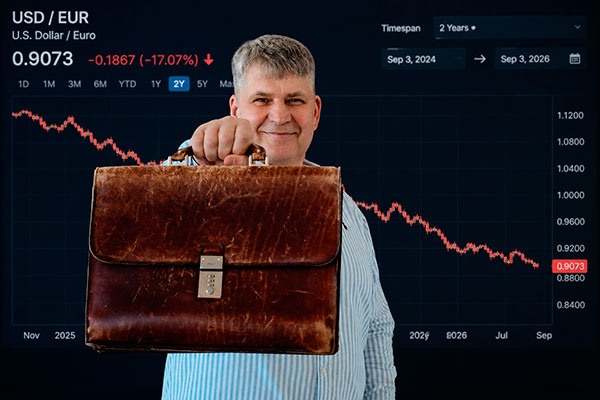
When the Market Finally Started Talking About Currency Risk
On August 24, 2026, we published "Fixed Income Begins with the Currency". It did not introduce a new investment idea. It simply articulated a principle that had guided our investment decisions for nearly two years.
Nearly two years ago, we began gradually reducing the U.S. dollar allocation within the bond component of our clients' portfolios. This decision was not based on the belief that the United States had ceased to be the world's largest economy. On the contrary, it reflected a more fundamental conclusion: the size of an economy alone does not guarantee the long-term preservation of a currency's purchasing power.
That observation led us to a broader principle: for international investors, currency risk is often more important than credit risk, because it is the currency—not the coupon—that ultimately determines a portfolio's real return.
At the time, this view was far from conventional. Most global investors continued to regard the U.S. dollar as the default currency for international fixed-income portfolios. Higher U.S. interest rates made dollar-denominated bonds particularly attractive, while decades of dollar dominance created the perception that currency risk was secondary.
We saw the situation differently.
To us, the U.S. dollar has always been not only the world's primary reserve currency but also a distinct investment risk. If a client's future liabilities and spending are denominated in euros, concentrating the defensive portion of the portfolio in dollars introduces a risk that is not always justified.
The Market Is Now Reaching the Same Conclusion
On September 3, Bloomberg published the article "World's Unusually High Dollar Exposure Risks Fueling Selloff", highlighting the risks created by excessive U.S. dollar exposure among global investors.
The message is straightforward. Years of dollar strength encouraged investors to accumulate substantial unhedged dollar positions. As long as the dollar appreciated, that risk remained largely invisible. As expectations toward the U.S. dollar begin to shift, currency exposure is increasingly becoming one of the primary drivers of international portfolio performance.
Bloomberg also points out that many institutional investors continue to under-hedge their currency exposure, leaving them vulnerable to further dollar weakness.
In effect, the market is beginning to discuss an idea that has shaped our investment approach for nearly two years.
Currency is not merely a technical characteristic of a portfolio. It is an investment risk in its own right.
That is why the currency decision comes before the bond selection.
Why This Matters Today
In recent years, discussions about fixed income have focused primarily on interest rates.
What is the yield on U.S. Treasuries?
When will the Federal Reserve begin cutting rates?
Which issuer offers the most attractive credit spread?
These are important questions. But for an international investor, they are not the first questions.
If a bond generates a 5% annual return while the currency in which it is denominated depreciates by a comparable amount against the currency in which the investor will ultimately spend that capital, the investment outcome changes dramatically.
That is why we have always believed that fixed income begins not with selecting a bond, but with selecting the right currency.
Why We Changed Portfolio Structure
We began reducing our clients' U.S. dollar exposure not because we were trying to predict short-term currency movements. We do not build investment strategies around foreign exchange forecasts.
It was a strategic decision based on a simple principle: the structure of assets should match the structure of future liabilities.
If an investor's long-term goals, spending, and economic life are centered in Europe, then the euro should form the foundation of the defensive portion of the portfolio.
This allows fixed income to fulfill its primary role: preserving purchasing power rather than turning the conservative allocation into an additional currency bet.
Andrievskii Verdict
We do not view Bloomberg's latest publication as a new investment idea.
Rather, we see it as an independent confirmation of the approach we adopted nearly two years ago and described in Fixed Income Begins with the Currency.
Our investment philosophy remains unchanged.
We continue to believe that when constructing an international portfolio, the primary question is not "Which bond should I buy?" but rather "In which currency should my capital be held?"
Because fixed income begins with the currency.
Only then come yield, maturity, and the issuer's credit quality.
Ultimately, it is the currency that determines whether the defensive portion of a portfolio will preserve its purchasing power when that capital is actually needed.
Aleksei Andrievskii | Advisory Board Member, Bendura Bank AG | Liechtenstein