After the Oil Storm: OPEC+ Chooses Between Price and Market Share
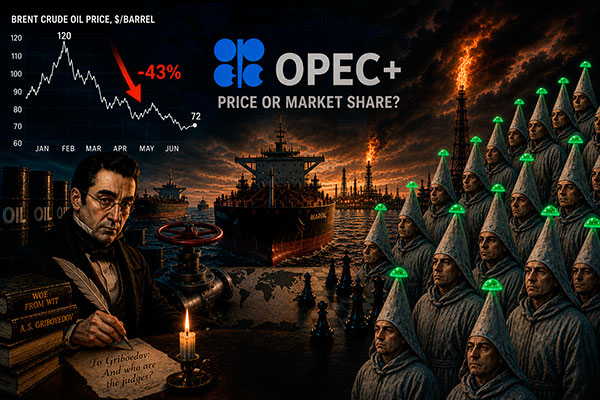
While investors continued discussing the risks of an oil shortage, the world's largest producers began preparing for a very different scenario. Seven OPEC+ countries led by Saudi Arabia and Russia agreed during Sunday's video conference to raise production quotas by another 188,000 barrels per day. The decision became another step in the gradual dismantling of production restrictions introduced several years ago to support the market.
Since the beginning of the Middle Eastern conflict, members of the agreement have already increased quotas by almost 940,000 barrels per day. At the same time, supplies through the Strait of Hormuz are recovering, Iranian oil is returning to the market, and global logistics are gradually normalising. A market that only recently feared a physical shortage of crude is increasingly discussing the exact opposite risk — oversupply.
Oil futures have already fallen by around 43% from their wartime peaks, approaching $72 per barrel in London, while leading investment banks warn about the possibility of a new period of global oversupply. This is why OPEC+ is beginning to face a question that only a few months ago seemed impossible.
The choice is gradually shifting from protecting price to protecting market share.
Over recent decades, the largest producers have repeatedly demonstrated their willingness to sacrifice the price of a barrel temporarily in order to preserve customers and export flows. Lost prices can be recovered through future production cuts. Lost market share is significantly harder to regain.
That is why major producers today are probably far more concerned about losing customers to competitors than about seeing oil trade a few dollars lower. Any vacant space in the market will quickly be occupied by producers from other regions of the world.
While investors focused on wars and geopolitics, the oil industry was doing what it has always done during periods of high prices — searching for new barrels. And finding them in places where only a few years ago nobody expected to achieve acceptable returns.
High prices transformed yesterday's marginal projects into economically viable investments. Norway aggressively expanded exploration and production in the North Atlantic, while African nations accelerated the development of fields that would have remained little more than attractive investor presentations if oil had stayed at $50 per barrel.
Another potential source of additional supply is already visible on the horizon. If the war in Ukraine eventually ends and global energy trade gradually normalises, the market could receive additional hydrocarbon supply together with lower logistics costs. The history of commodity markets shows that after major geopolitical shocks the world usually emerges not with fewer, but with more production capacity.
For the global economy this effectively represents a reduction in the tax on growth. Cheap oil quickly translates into cheaper air tickets, lower logistics costs and reduced production expenses. This is precisely why the first winners of the new cycle are not oil companies but energy consumers.
The monetary effect may be even more important. Lower energy prices reduce inflationary pressure across almost every sector of the economy — from transportation and industry to retail and agriculture. If the trend continues, cheap oil may do more to prevent another round of interest rate increases than dozens of speeches by central bankers.
Andrievskii Verdict
Today markets are frightened and volatile. They extrapolate today's shortages into eternity, hedge potential price spikes years into the future and attempt to evaluate tomorrow through the lens of the latest crises.
Commodity cycles, however, rarely move in straight lines. The longer high prices persist, the more capital flows into exploration, production and infrastructure, creating the foundations for future oversupply.
For OPEC+, the greatest risk today is not oil at $70 per barrel. The greatest risk is oil that someone buys from somebody else.
This is why, in the medium term at least, major producers will defend not only the price of a barrel but also their place in the global market.
Perhaps the global economy will receive a brief respite. A respite before the next market madness, the imperial ambitions of yet another dictator, or torchlit marches of young men in white hoods convinced that history begins with them.
The world is changing too quickly. It is becoming less well-read, less intellectual and considerably more emotional. Which means that the analysis written late at night by an analyst trying to think professionally and rationally may tomorrow be fit only for the fireplace, leaving us with nothing to do except write to Griboyedov: "And who are the judges?"
Aleksei Andrievskii | Advisory Board Member, Bendura Bank AG | Liechtenstein